

You know, there are only three known references to Jesus’ direct interactions with His mother after His public ministry began. These references are very enlightening.
The Savior’s ministry has just begun. He returns to Galilee from His baptism at Jordan, and His temptation experience in the Judean wilderness. He comes with His disciples to a wedding feast at Cana. It may well have been a member of His family getting married since it was Mary who was in charge of the feast – we really don’t know. But during the course of the festivities, they run out of wine. Mary comes to Jesus in her need and says to her son, “… They have no wine.” (John 2:3)
Does she know that He has the power to work miracles? – Of course. Has He done it before? - Of course. Now, Jesus could have considered the request trivial, and scoffed at it. But He doesn’t. I love the way Jesus talks to His mother. “… Woman,” he says, “what wilt thou have me to do for thee? that will I do; for mine hour is not yet come.” (JST John 2:4)
Now note it: The use of the term ‘woman’ was not like we use it today. It was then a title of great respect. Even according to some, in this context, it was a reference to a woman of queenly caliber. It was as though He was saying to her, “Mother, I will do for you whatever you want. Your wish is my command.” I like that.
And that is exactly what the Master does. Miraculously He creates a more than ample supply of the highest quality wine to finish out the feast.
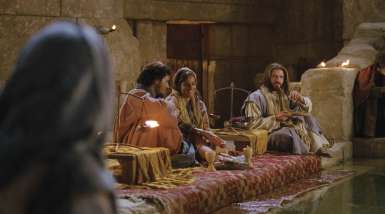
Now let me take you back. Remember what He said to her? - “Woman, what wilt thou have me to do for thee? that will I do; for mine hour is not yet come.” What did He mean, “[His] hour is not yet come”? Well, I wondered about this, and so I studied it. Not surprisingly, it turned out that Jesus’ hour was ‘Gethsemane and Golgotha.’ He was born for that moment of moments when He would suffer and die to save the human family. So in effect, the Savior was saying to His mother, “I can help you now, dear, but not then.”
And yet – and this is so significant – when do we find the next major interaction between Jesus and His mother? It comes in the midst of His ‘hour.’ He is hanging on the cross of Calvary suffering an incomprehensible weight of agony, and from that cross He looks down where His aged mother stands with John, the beloved disciple. Both are grieving near the cross. He looks at His mother, and with the tenderest of concerns, he says to her, referring to John, “… Woman, behold thy son!” (John 19:26) And then He looks over at John and says, “… Behold thy mother! …” (John 19:27) And from that hour, John “… took her unto his own home” and cared for her. (John 19:27)
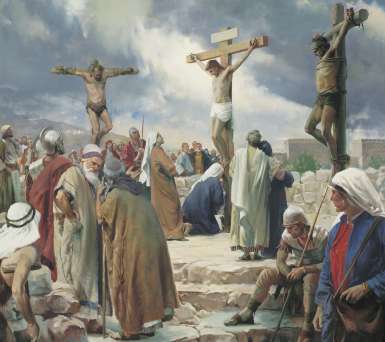
With the salvation of worlds innumerable, and of an infinite humanity weighing upon Him, I find it touching – overwhelming, that Jesus still had the time and the concern to see to the temporal salvation of His mother as one of His last acts of kindness before He died.
If only we would all do the same… Surely, it is no accident that Jesus’ public ministry began and ended with tender acts of kindness for His mother.
Story Credits
From John 2 & 18
Glenn Rawson – March 2002
Music: Serve Thy Mother – Michael Leavitt
Song: She – Cherie Call
